
WELCOME BONUS 300%
UP TO €2000 + 100
FREE SPINS
UP TO €2000 + 100
FREE SPINS
Home → Blackjack
Blackjack at Ozwin Casino: Variants, Rules and Payouts
What doesn't count as Blackjack after Split?
In certain Blackjack variants, a split hand may not qualify as a Blackjack. This is particularly relevant when a player splits Aces; typically, only a natural 21 on the first two cards is considered a Blackjack. For instance, if a player is dealt two Aces and splits them, drawing a 10-value card to one Ace and a 9 to the other, neither hand would be a Blackjack. This rule impacts the payout structure, as a natural Blackjack usually pays 3:2, whereas a 21 from multiple cards may pay 1:1.
The distinction between a natural Blackjack and a 21 formed after a split is crucial for understanding payout differences. A natural Blackjack, achieved with the initial two cards, typically offers a superior return. For example, on a €100 bet, a 3:2 payout yields €150, whereas a 1:1 payout results in €100. This difference can significantly affect the house edge and player returns over time.
This specific rule is often found in games that aim to retain a lower house edge through other liberal rules. The Blackjack Liberal Vegas Strip, for instance, offers a 3:2 payout and a low house edge of 0.28% due to favourable combinations like S17, DAS, Resplit, and Late Surrender. However, the precise handling of post-split 21s can vary, influencing the overall return to player (RTP).
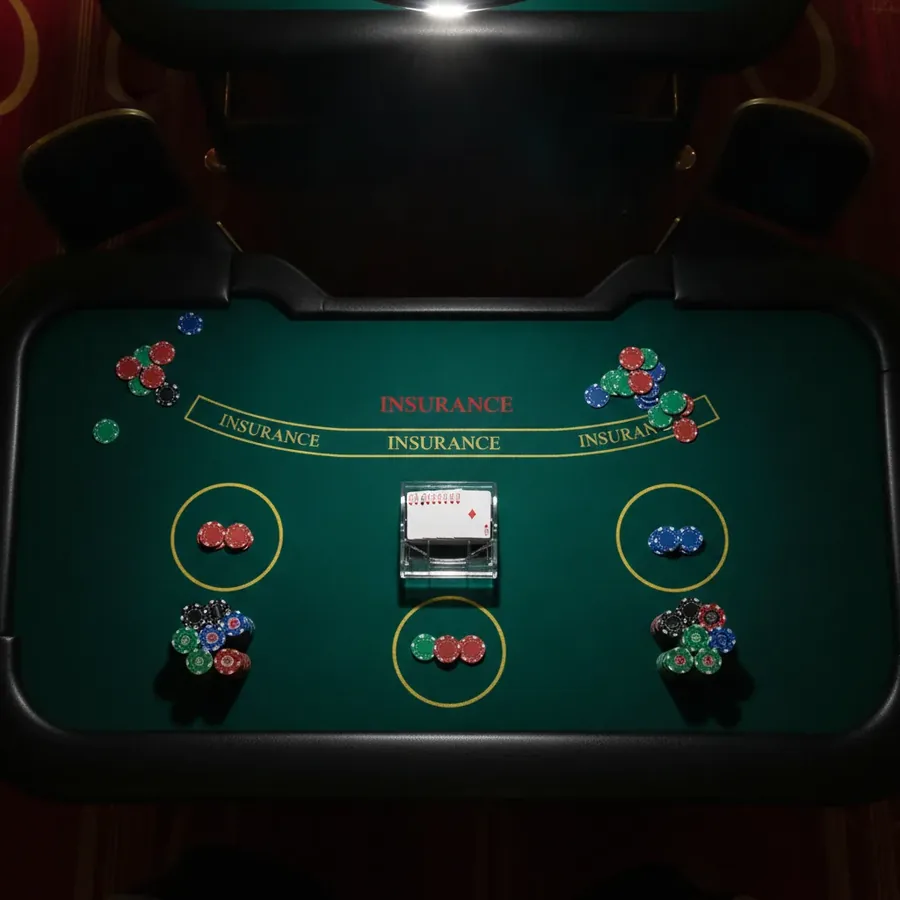
Which rule variants does the software show?
The software presents several Blackjack rule variations, each affecting the house edge and RTP. One notable variant is Blackjack with a 6:5 payout instead of the standard 3:2, which increases the house edge by 1.39 percentage points. For example, a €10 bet would return €12 instead of €15, a significant reduction in player winnings.
Other rule sets aim to reduce the house edge, such as Blackjack Liberal Vegas Strip. This variant boasts a low house advantage of 0.28% with an RTP of 99.72%, attributed to a favourable combination of rules including S17, DAS, Resplit, and Late Surrender. Such combinations are designed to offer a more player-friendly experience.
Further rule modifications impact the game's dynamics. For instance, the option to Surrender, specifically Late Surrender, can improve RTP by approximately 0.08 percentage points by allowing players to forfeit half their bet after the dealer checks for Blackjack. Conversely, rules like Dealer Hits Soft 17 (H17) increase the house edge by 0.22 percentage points.
Surrender vs Playing Out on 16 vs 10
The decision between Surrender and Playing Out on a hand of 16 against a dealer's 10 is a critical strategic choice. Late Surrender allows a player to give up half their bet after the dealer checks for Blackjack, effectively reducing potential losses. This rule modifier can improve RTP by approximately 0.08 percentage points, making it a valuable option for players.
In contrast, playing out a hand of 16 against a dealer's 10 involves standing or hitting, with the goal of not busting while trying to beat the dealer's hand. Standing on 16 is often considered risky, especially when the dealer shows a strong upcard like a 10. The house edge for a standard 6-deck game can be around 0.46% when using optimal strategy.
The availability and impact of surrender options can differ. While Late Surrender is a common rule, Early Surrender, which allows a player to forfeit before the dealer checks for Blackjack, is much rarer but significantly more beneficial, potentially reducing the house edge by up to 0.6 percentage points. The distinction between these surrender types is vital for strategic decision-making.
Step-by-step Split at the Live Table
At live dealer tables, the process of splitting cards involves specific steps and adherence to table rules. When a player receives two cards of the same rank, they have the option to split them into two separate hands. This action requires an additional bet equal to the original wager for each new hand created.
Following the split, the dealer then deals an additional card to each of the newly formed hands. Depending on the specific rules of the live game, players may be allowed to resplit if another card of the same rank appears, or double down after a split (DAS). For example, DAS allows doubling down on a two-card total after splitting.
The rules governing splits can vary between live casino providers like Evolution. For instance, Infinite Blackjack and Lightning Blackjack offer unlimited seats, but the specifics of resplitting Aces or doubling down after splitting might differ. These variations can subtly alter the game's RTP, with DAS potentially reducing the house edge by around 0.14 percentage points.
Side Bets Increase House Edge to 5 Percent
Side bets in Blackjack, such as Any Pair, 21+3, Hot 3, and Bust It, often come with a significantly higher house edge compared to the main game. For example, the Insurance side bet, offered when the dealer shows an Ace, has a substantial house advantage of 7.47% in a 6-8 deck game, with an RTP of only 92.53%.
These additional wagers are designed to be lucrative for the casino, providing an extra layer of risk and potential reward for players. While the main Blackjack game might have a house edge below 1%, these side bets can push the overall house advantage considerably higher, sometimes reaching or exceeding 5%. This is especially true for some of the more complex side bet structures.
For instance, the 21+3 side bet, which combines the player's first two cards with the dealer's upcard to form a three-card poker hand, can have a house edge that varies depending on the specific payouts offered. Similarly, the Bust It side bet, which pays out if the dealer busts, also typically carries a elevated house edge, contributing to the overall casino advantage.
Blackjack variants at a glance
| Variant | Payout | House edge | Rule | Bet range |
|---|---|---|---|---|
| Blackjack Ein Deck, klassische Regeln, 3:2 | 99.85% | 0.15% | Weniger Decks = niedrigerer Vorteil; ein Deck gibt ca. −0.48 Prozentpunkte gegenüber 8 Decks. Oft durch 6:5 Auszahlung kompensiert. | Blackjack 3:2, Gewinn 1:1 |
| Blackjack Liberal Vegas Strip (liberale Regeln, 3:2) | 99.72% | 0.28% | Günstigste Regelkombination: S17 + DAS + Resplit + Late Surrender. Standardabweichung 1,15 | Blackjack 3:2, Gewinn 1:1 |
| Blackjack Surrender (Late Surrender) – Regel-Effekt | n.a. (Regel-Modifikator) | −0.08 Prozentpunkte | Spieler gibt Hand nach Dealer-Blackjack-Prüfung auf, verliert die Hälfte des Einsatzes. Verbessert RTP um ca. 0.08 Prozentpunkte. Early Surrender ist wesentlich wertvoller (bis −0.6 Prozentpunkte), aber extrem selten. | Rückzahlung 50% des Einsatzes |
| Blackjack Insurance / Versicherung (6–8 Decks) | 92.53% | 7.47% | Separate Nebenwette bis 50% der Hauptwette, wenn der Dealer ein Ass hat. Basisstrategie schreibt IMMER Ablehnung vor (außer Karten zählen bei True Count ≥ +3). Bei einem Deck Vorteil ≈ 5.88% | Insurance 2:1 |
| Blackjack Split / Double / H17 – Regel-Effekte | n.a. (Regel-Modifikatoren) | H17 +0.22 Prozentpunkte; RSA −0.08 Prozentpunkte; DAS −0.14 Prozentpunkte | Dealer Hits Soft 17 verschlechtert RTP um 0.22 Prozentpunkte; Resplit Aces verbessert um 0.08 Prozentpunkte; Double After Split verbessert um ca. 0.14 Prozentpunkte; 6 Decks statt 8 – ca. 0.02 Prozentpunkte. | Double – Einsatz ×2 mit einer Karte; Split – bis 4 Hände; Ass-Split meist mit einer Karte. |
| Blackjack 6 Decks, S17, DAS, DOA, Auszahlung 3:2, Basisstrategie | 99.54% | 0.46% | Dealer steht auf Soft 17; Verdopplung auf jeder Zweierkarte; Verdopplung nach Split erlaubt; keine Aufgabe. Basisstrategie ist für diesen Wert zwingend | Blackjack 3:2, normaler Gewinn 1:1, Insurance 2:1 |
How long does a Live Blackjack round take?
Infinite Blackjack, provided by Evolution, offers an unlimited number of seats at the table, allowing players to join at any time. The game features four side bets: Any Pair, 21+3, Hot 3, and Bust It. With a stated RTP of 99.47%, this variant aims to provide a consistent blackjack experience. The betting range extends from 1 EUR up to 5,000 EUR.
Lightning Blackjack, also from Evolution, also accommodates an unlimited number of players, ensuring accessibility. This variant incorporates Lightning multipliers that can increase winnings on a hand by up to 25x. The RTP for Lightning Blackjack is listed at 99.56%, slightly higher than Infinite Blackjack. The betting range for this game is between 1 EUR and 2,500 EUR.
Blackjack Party, another Evolution offering, is designed for a more social atmosphere with two hosts. While it provides a lively setting, the betting range is narrower, from 1.00 EUR to 1,000 EUR.
Chose Wrong Table for 5 EUR Bankroll
With a 5 EUR bankroll, selecting the appropriate table is crucial for sustained play. For instance, Blackjack Party has a betting range starting at 1.00 EUR, allowing for multiple hands to be played with a 5 EUR balance. However, considering the possibility of losses, a 5 EUR bankroll may be depleted quickly if unlucky.
Infinite Blackjack offers a wider betting range, from 1 EUR to 5,000 EUR, making it potentially suitable for a small bankroll, as the minimum bet is accessible. However, the potential for larger bets by other players or the desire to bet more oneself could lead to faster depletion of a 5 EUR bankroll. The RTP is 99.47%.
Lightning Blackjack, with its betting range of 1 EUR to 2,500 EUR, also presents a similar situation for a 5 EUR bankroll. While the minimum bet is low, the presence of multipliers could tempt players to increase stakes, potentially leading to rapid bankroll exhaustion. The RTP is 99.56%.
RNG draws cards from virtual eight-deck shoe
In RNG-based blackjack variants, cards are drawn from a virtual shoe, often comprising eight decks. This setup influences the house edge and the effectiveness of certain strategies. For example, Blackjack 6 Decks, with specific rules like S17, DAS, and DOA, offers an RTP of 99.54% and a house advantage of 0.46%.
The concept of an eight-deck shoe is relevant to understanding the probabilities associated with different blackjack outcomes. For instance, the payout for a natural blackjack is typically 3:2, as seen in Blackjack 6 Decks. However, if the payout is reduced to 6:5, the RTP drops to 98.15%, increasing the house advantage to 1.85%.
Variations like Blackjack Liberal Vegas Strip, which uses liberal rules and a 3:2 payout, boast a high RTP of 99.72% with a house advantage of only 0.28%. This suggests that the number of decks, combined with other rule variations, significantly impacts the game's fairness and theoretical return to player.
Seat change at the Live Table in 20 seconds
The live blackjack tables, such as Infinite Blackjack by Evolution, are designed for continuous play. The betting range for Infinite Blackjack is 1 EUR - 5,000 EUR.
In games like Blackjack Party, also by Evolution, the social aspect might influence player turnover. Although a specific seat change duration is absent, the aim of live casino providers is to minimize downtime. This ensures players can resume their gaming sessions with minimal interruption after placing bets or waiting for a seat.
The general expectation in modern live dealer environments is for rapid seating arrangements. Given the competitive nature of online casinos, a prompt seat change, potentially within a short timeframe like 20 seconds, would be a standard feature to maintain player engagement. The RTP for Lightning Blackjack is 99.56%.
Splitting tens costs expected value: better stand
When faced with a total of ten, splitting tens is generally not advisable according to basic strategy, especially in games where the house edge is a consideration. While rules like Double After Split (DAS) might seem beneficial, they do not compensate for the negative impact of splitting tens. Blackjack 6 Decks has a house advantage of 0.46%.
Splitting tens reduces the player's expected value because a player's best chance of forming a strong hand lies in combining a ten with another ten or a high card. Creating two separate hands from two tens often leads to weaker outcomes compared to standing on a hard 20. The RTP for Blackjack 6 Decks is 99.54%.
For instance, in a game with an eight-deck shoe and standard rules, standing on a pair of tens yields a hard 20, which is a strong hand against most dealer upcards. Splitting these tens would result in two hands, both starting with 10, which are statistically less likely to win than a single 20. The payout for blackjack is 3:2.
Double Down vs Simple Hit on 11
Doubling down on a total of 11 in Blackjack offers a significant advantage, with a house edge of 0.28% when liberal rules like S17, DAS, and Resplit are in play. This contrasts with a simple hit, which maintains a higher house edge if such advantageous rules are absent. The decision to double down on 11 is a core strategic element that impacts player returns.
In contrast, a basic Blackjack strategy without liberal rules can still yield a favourable house edge, but the opportunity to maximise winnings on a strong hand like 11 is diminished. For instance, the Blackjack Liberal Vegas Strip variant, with an RTP of 99.72%, rewards doubling down effectively. A player opting for a simple hit on 11 in a less favourable ruleset misses a crucial opportunity.
Understanding these distinctions is vital for players aiming to minimise the house edge. The ability to double down on 11, particularly in games like Blackjack Liberal Vegas Strip, directly translates to a potentially higher return on investment over time. Ignoring this strategic option can lead to a less optimal outcome, increasing the casino's advantage.
No Double Down on three cards
The restriction on doubling down after receiving three or more cards, common in some Blackjack variants, significantly impacts gameplay and potential winnings. This rule modification, unlike others such as the payout ratio, can add a notable percentage to the house advantage. Players must be aware of this limitation to avoid strategic missteps.
For example, in a game with a standard 6-deck shoe and a 3:2 payout, the house edge is typically around 0.46%. However, if the rules disallow doubling down on three cards, this edge can increase, negating some of the benefits from other favourable rules like S17 or DOA. Players familiar with Blackjack Split / Double / H17 rules will note these are often bundled with specific double-down allowances.
The consequence for a player is a reduced ability to capitalise on favourable situations. If a player's hand reaches three cards and they hold a strong total, the inability to double down means a potentially lost opportunity for a larger payout, thereby favouring the casino's overall retention rate.
Clicked Too Late: Hand Is Automatically Held
In live dealer Blackjack games, such as Evolution's Infinite Blackjack, timely decisions are paramount. If a player fails to act within the allotted time for their turn, their hand is automatically held based on the default game rules. This can lead to suboptimal outcomes if the player intended a different action, like hitting or standing on a specific total.
This automatic hold feature is a mechanism to maintain game flow, especially in variants like Infinite Blackjack which accommodate an unlimited number of players. While the RTP for Infinite Blackjack is a competitive 99.47%, a player's individual session outcome can be negatively affected by missed opportunities due to late decisions. The game does not offer 'Late Surrender', which is a rule that allows a player to forfeit half their bet after the dealer checks for blackjack.
Consequently, players engaging with live Blackjack tables should exercise caution and be prepared to make their decisions promptly. Failing to do so means relinquishing control over their hand's progression, potentially leaving money on the table or making a less advantageous play than intended, thereby indirectly increasing the house edge for that particular hand.
Soft 17: Dealer Hits or Stands
The rule dictating whether the dealer hits or stands on a 'Soft 17' is a critical factor influencing the house edge in Blackjack. When the dealer hits on Soft 17 (a hand totalling 17 that includes an Ace counted as 11), it increases the house advantage by approximately 0.22 percentage points compared to when the dealer stands.
For instance, a game with a 3:2 Blackjack payout and other standard rules might offer an RTP of 99.54% if the dealer stands on Soft 17. However, if the dealer is required to hit on Soft 17, the RTP decreases to around 99.32%, making it a less favourable proposition for the player. This rule directly affects the frequency of dealer busts and successful player hands.
Therefore, players seeking the best possible odds should prioritise Blackjack variants where the dealer stands on Soft 17. This seemingly small rule variation can have a tangible impact on a player's long-term profitability, as it consistently lowers the casino's inherent advantage over many hands played.
Blackjack Payout 3:2 Explained in Detail
A 3:2 payout for a Blackjack is a fundamental rule that significantly benefits the player by reducing the house edge. This means for every €2 wagered, a player wins €3 if they achieve a Blackjack (an Ace and a ten-value card on the initial two cards). This payout structure is standard in many favourable Blackjack games.
In contrast, a 6:5 payout for Blackjack, as seen in some variants, is substantially less advantageous. If a €10 bet pays 6:5, the win is €12, whereas a 3:2 payout on the same €10 bet would yield €15. This difference of €3 per Blackjack equates to a significant increase in the house edge, approximately 1.39 percentage points higher for 6:5 games.
The impact of the 3:2 payout versus a 6:5 payout is substantial for players. Opting for games that consistently offer the 3:2 ratio is a key strategy to minimise the casino's advantage and maximise potential returns over the course of play, especially when compared to less favourable 6:5 Blackjack tables.
Contact
Live - online chat
Banking






Providers









Ozwin Casino 2026